Syncmind
A speculative critical design project built for experimentation: an AI agent that *optimizes* the daily practices of young adults with social anxiety for maximum social performance.
Duration
Oct - Dec 2025
Context
Team project (five people) for the HCI Master's program, under the theme "the critical speculations of AI in everyday life."
My Roles
User Research, Information Architecture, UX Design, User Test Planning & Facilitation, Planning, Prototyping

The Challenge
What if an AI could monitor how drained or energized you feel in social situations, and then plan your activities accordingly?
AI agents are becoming part of everyday routines, usually presented as helpful. We took that framing and pushed it: how might an extremely supportive tool for young adults with social anxiety shape their social practices?
We built Syncmind as a speculation of a "potential future solution", tested it with people in our target group, and used their reactions to ask what happens if this kind of AI becomes the new normal.

Meet Syncmind
Syncmind reads your social energy through a sensor sticker worn on your throat and data from your phone, then takes control of your calendar. When you're overwhelmed, it locks your events and sends you home. When you're doing well, it adds social plans, because you can, and "as society expects", you should.
Syncmind has two parts: an app that manages your social life, and a sensor sticker that reports on your body.
The app: a planning agent with your calendar
Syncmind calculates your social energy in real time from a daily questionnaire, your messages, location, calendar, and microphone, plus the sensor's readings. Then it acts on the result.
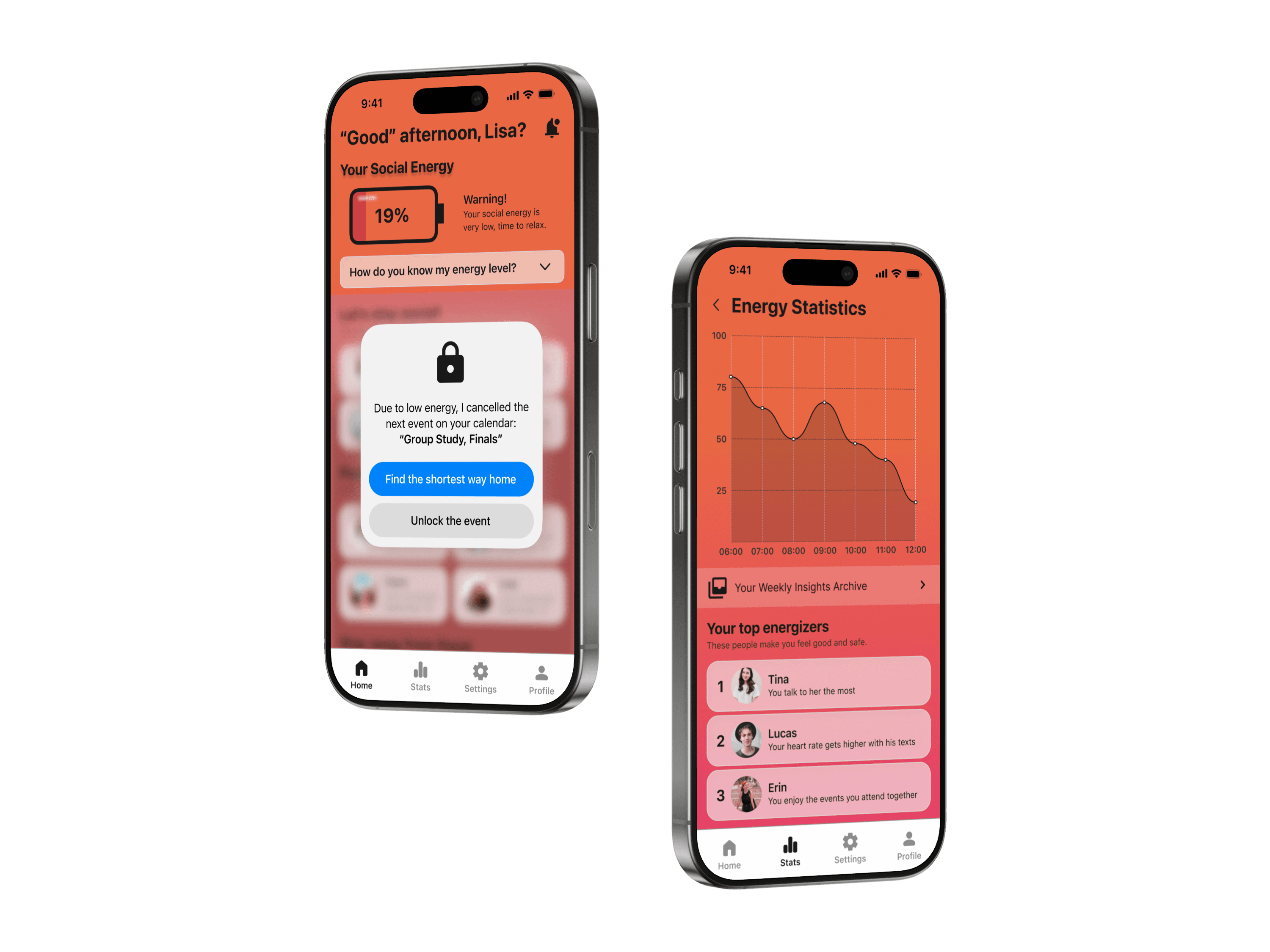
When energy is high, it adds plans. The interface turns green, and the app schedules social events based on your preferences and recent interactions, so you can "put yourself out there while you can." If attending isn’t feasible, it sets conditions for reaching out in other ways.
When energy is critically low, it takes over. The interface turns red. The app locks upcoming events that might trigger anxiety, reschedules the rest of your day, and guides you home. You can still attend a locked event, but only by completing energy-boosting tasks the app assigns. The "way out" exists, but on the app’s terms. We designed it to test how people react when an AI has the final say over their choices.

The sensor: making your anxiety visible
A small sticker worn on the throat measures heart rate, tremors, and sweating. The throat placement serves two purposes: it sits near the arteries for an accurate pulse, and it's visible in daily life. That visibility lets wearers with social anxiety signal their vulnerability and ask for others' understanding of their social challenges.

(AI-generated portrait)


Design Process
Initial Exploration
Besides the literature review, we conducted interviews with 5 participants aged 22 to 29 who live with social anxiety.
Most were currently content with their social lives, but everyone described the same challenge: socializing brings sincere connection and growth, yet it drains them, and they spend their energy deciding when to push through and when to cancel.
They shared a strong wish to "perform well" socially. But canceling events when they need it brings relief, but then FOMO and self-criticism. As one put it, "canceling a triggering event feels good in the moment... But then I might miss out just because I’m shy, and that is not a great feeling."

Societal expectations worth addressing
Two social norms kept surfacing in the interviews.
Being outgoing and confident is treated as the default good, so participants feared being seen as anxious and tried to hide it, which turns socializing into a performance.
An active social life is treated as proof of health and success, so taking breaks from social life feels like a crime for them.
Participants were also skeptical of AI as a companion to talk to, but open to AI that pushed them toward their real friends. That left two needs: understanding which friendships energize them and which drain them, and getting guidance on when to engage or step back. The usual answer would be a supportive chatbot. We went the other way and imagined an AI as an emotional load calculator, one that takes the "perform well" norm literally and optimizes people for it.


Building the Product
Two feature decisions I contributed
The app locks events directly: Interviews were addressing the "guilt" people feel once they cancel events. Instead of keeping things as "suggestions", passing the blame to an external "agent" deciding through data and taking over their calendar made the question of AI autonomy impossible to avoid.
A "keep up with friends" section on the homepage: It shows which friends you haven't been in touch with and how each one helps you stay energized. It is the most caring-looking part of the app, and it also turns relationships into an energy source to be managed. It's small and not interactive, but it sits where every user sees it.
From sketch to prototype
I digitalized the full prototype, taking the team's sketches through to an interactive hi-fid version.


How People Reacted
We tested Syncmind with six participants aged 18 to 29, all of whom either identified as experiencing social anxiety or had a clinical diagnosis. Each session had two parts: task-based user testing, then a semi-structured interview about how AI should quantify and manage social behavior.
My part: I structured the test plan and facilitated one of the sessions with a participant.
At first, they read "control" as a "suggestion".
Participants initially took the app's added and canceled events to be recommendations. Once they realized Syncmind was acting on their behalf, the reaction changed, and some called the decisions "harsh" or "punishing."
What? If I cancel, I need to arrange a brunch instead? So now the app is punishing me!? (Participant 3)
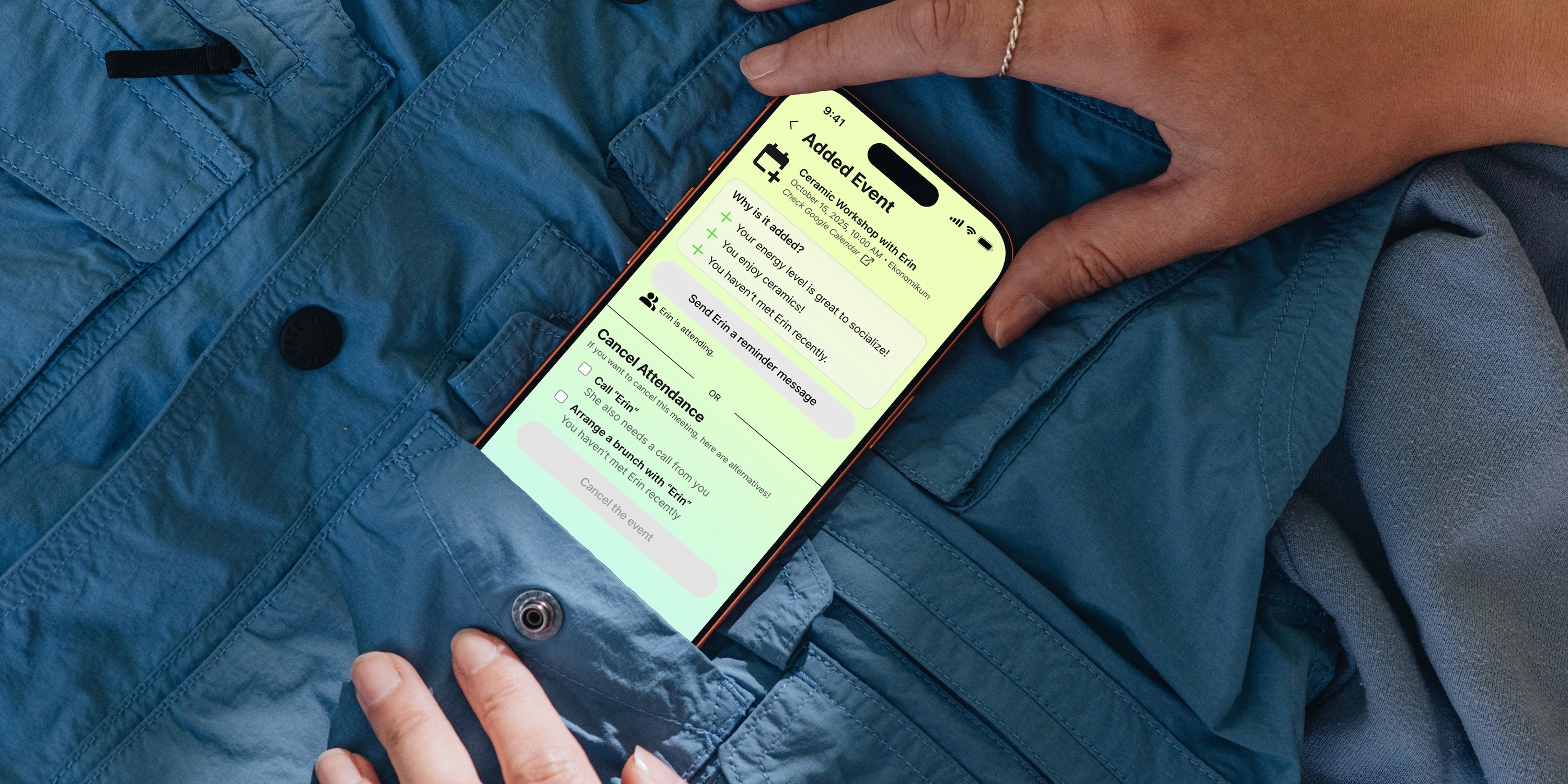
Adding plans was welcome. Canceling them wasn’t.
When the app added an event, some participants were surprised but open, especially when the event page showed the other person had already confirmed. When it canceled events, nearly everyone objected, since it overrode responsibilities they had prioritized.
"I am not an initiative taker, so if this app plays match-maker and calls people out for an event, I'd be grateful!" (Participant 1)
"It's good if it suggests, but not if it orders." (Participant 2)
The app asked for more data than people would give.
Participants repeatedly questioned how their data was collected, stored, and shared. Three of the six were confused about the sensor and the permissions, and wanted a clear explanation first.
They wanted an advisor, not an authority.
Several participants saw value in the app as a mirror for their relationships and energy, but only if the final decision was still theirs.
"I trust data as a scientist, so I would keep an eye on the app to see the people that energize me, but it would still be me to decide who I really want to spend time with." (Participant 2)

What It Revealed About AI Practices
Mistaking "control" for "care"
Participants read the added and canceled events as recommendations, and only objected once they realized the app was acting for them. Automation framed as help can go unquestioned until it interrupts what is important in your life.
The relief is real, and so is the cost
An AI agent that decides when you attend could lift the guilt of canceling without an excuse. But the same mechanism can shrink your exposure to uncomfortable situations, and those are often how people grow social confidence. Over time, it could reshape who we spend time with. If we rely on an AI's account of our social energy, we risk letting it change our behavior, our opinions, and eventually our communities. The societal expectations (be outgoing, be available) don't disappear. They get handed to a system that applies them for us. An agent could strengthen the very norms about how we "should" behave that made the load heavy in the first place.

Personal Takeaways
Following my urban design education and professional work experience, this was my first-ever critical design project, and the hardest part was unlearning the urge to support a human-centered solution. I’m used to making things work for people. But here we had to problematize a norm, and design something that goes wrong in a believable way.
What stayed with me is how probable this dystopian solution is, considering today's startup dynamics. Our lives are now entangled with systems that change the way we live, so every automated decision raises a question of agency ownership: who holds the decision, and who decides the "ideal way" of a healthy social life, the person or data? With so many self-tracking apps out there, automating sensitive parts of life is already a direction technology is moving, and something like Syncmind could be built by people who never think through the long-term effects. They might not consider how easily we hand over control, or how stepping back from social situations can look like a fix as the root causes of anxiety go unexamined.
Syncmind helped us to reflect on the balance between support and control, revealing how AI can both help and harm our social practices. For our detailed analysis, you can check our report.