Attuna
An Arduino-supported board game where teams of two act as construction workers, using bodily attunement in silence to locate parcels on a dynamic board.
Duration
May - Jun 2026
Context
Developed with a team of four for the Embodied Interaction Design course at Uppsala University
My Roles
Concept & Game Mechanics Design Arduino Hardware Configuration Playtest Planning & Facilitation

The Challenge
In this project, our challenge was to design a physical game that explores "Embodied Attunement”: how people physically calibrate to each other, objects, and their environment through play.
Our design process evolved around this research question:
"How can we design a game interaction where attunement and physical coordination instinctively emerges as a by-product of players pursuing a shared goal?"
A simpler translation: Rather than making the “attuned state” the final goal of players, we wanted “attunement” to become a “hidden tool” players need to win. As researchers, we explored the ways two individual bodies can naturally “click” and focus on a target together.


The Game
Attuna is a cooperative 2v2 dexterity game, where teams of two must deliver parcels to precise coordinates on a chess-style grid.
The twist is… players are not allowed to talk. Teams’ success relies entirely on how well players sync up. They must navigate through physical obstacles by relying solely on spatial awareness and inter-bodily coordination to read each other’s intentions.
The Setup
The board uses a chess-style coordinate system. One side displays shape columns; the opposite side displays numbered rows. Teammates sit facing each other. In each round, opponents draw coordinates for the team. One teammate secretly receives the shapes; the other receives the numbers.

To push the physical experience even further, players aren't allowed to see coordinates. Shapes and numbers are placed on a hidden tray underneath the board, and players have to figure out their secret coordinates entirely by touch. The main challenge is that you don't know your teammate's coordinates, and you cannot speak. You must physically guide each other to the correct drop-off point while playing.

To deliver a parcel, teammates balance a shared "plank" using just one finger each, pushing against it for stability. Picking it up triggers a 30-second countdown buzzer. Through physical negotiation, teams drop the parcel on a final coordinate.
Before each round, all players add physical obstacles to the board. With four new obstacles introduced per round, the layout constantly changes and forces teams to navigate increasingly complex routes.
The Result: Forced Attunement
To survive the obstacles and agree on a drop-off spot, teammates are left with no choice but to physically sync up. The concept of "attunement" happens naturally as players become familiar with each others’ movements and figure out how to negotiate through the push-and-pull of the plank.
The Design Process
Moving Around & Finding the Fun (Ideation)
We started this project by moving around. Through bodystorming*, our team realized we naturally synced up best when we were thrown into dynamic situations and try to collaborate on a certain goal.
*Bodystorming: a design and ideation technique where people use physical movement, roleplay, and simulation to test ideas instead of just discussing.
But we quickly hit a wall: if the only goal of the game is to "attune", it just becomes a calibration test. Once players figure out the trick, the game is over. To keep the fun alive, we needed unpredictability. If the environment is constantly changing, players are forced to continuously adapt and stay connected.


The "What Ifs" and Initial Ideas
After a lot of rapid sketching, it was time to test the ideas using objects. We asked ourselves a lot of "what ifs" to see what makes players’ bodies to attune each other: What if they can't see each other? What if they only use one finger? What if the board layout constantly changes? What if no one actually knows where to go?
We thought about the classic awkwardness of two people trying to carry a heavy couch down a narrow corridor. Our very first prototype asked two players to transport a pen across a board without grasping it. With no talking allowed, the pressure on the pen became the only way to communicate.

During the initial tests, we noticed a major flaw: when teammates shared a goal they both knew, their focus locked entirely onto the destination instead of each other. We needed to make attuning to your partner an absolute obligation. To fix this, I pitched a twist: what if we gave neither player the full picture?
To force embodied attunement to each other, we blindfolded their logic by distributing the coordinates partially. If one player only knows the rows, and the other one knows the columns, they can’t mentally plan a route. They have to physically negotiate every step together.

Introducing Arduino
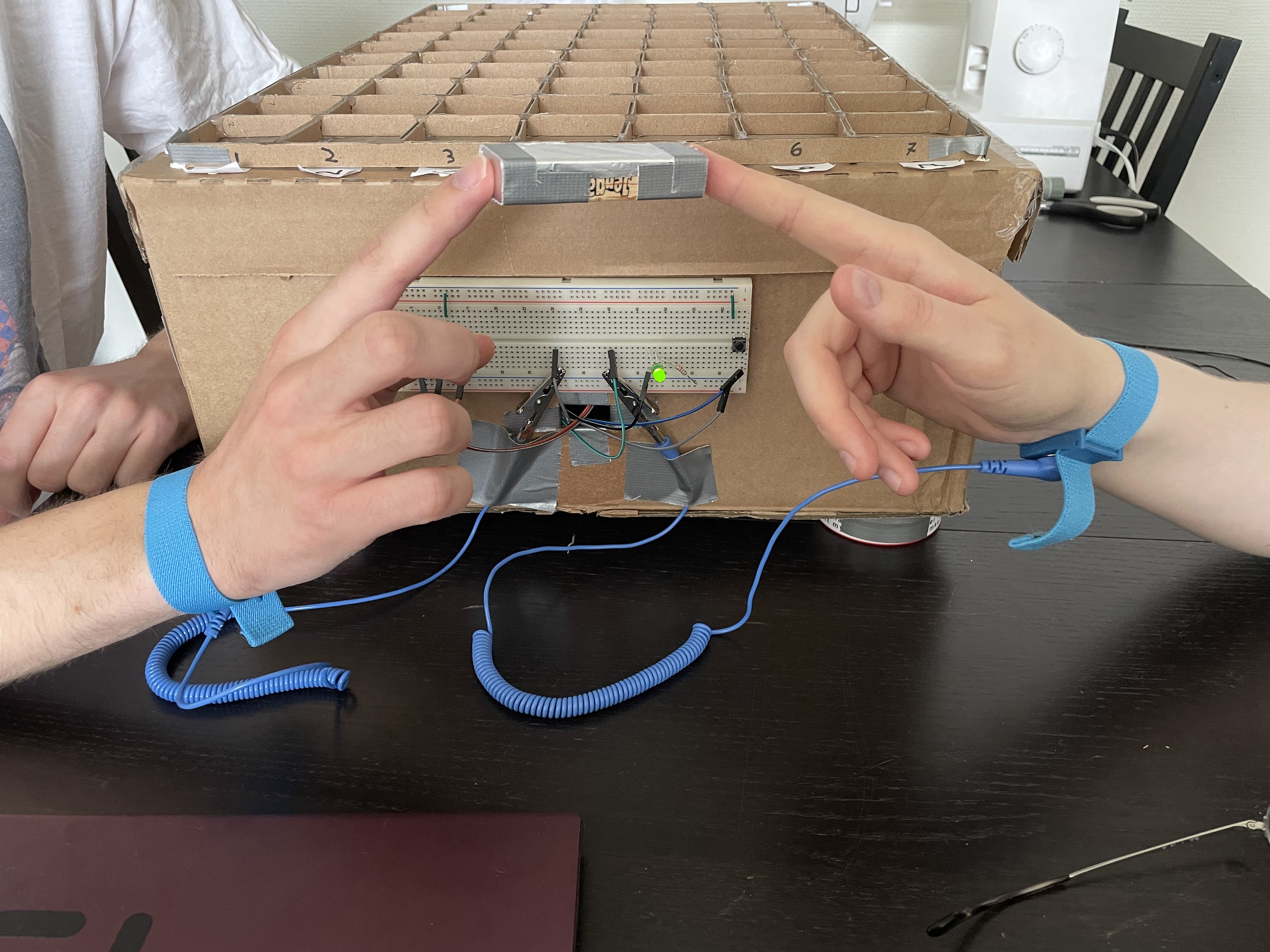
To make that physical synchronization feel urgent between players, we configured a 30-second ticking buzzer to act as a game master. This was done by using metal plates as finger attachments and wrapping aluminum foil around the plank to make it conductive. When both players touch the plank, their bodies close a circuit and trigger a 30-second countdown buzzer and an LED light.


The Playtest
Introducing our first prototype to test players was fun… and chaotic. During the first playtest, we were looking for two main things:
Did the game dynamics allow players to attune each other?
Did the tech solution function well, and support the gaming experience?
Good news: game format worked!
The first half of the playtest was conducted without the Arduino system and metal fingertips strapped, to focus on the rules and game dynamics.
The asymmetrical information system worked as envisioned. Not knowing their partners’ coordinates and having multiple drop-off options created conflict points where players had to attune to each other's bodily reactions and nonverbally negotiate their path around the game board.
As players became familiar with each other and the game dynamics each passing round, they felt more comfortable switching the “leader” and “follower” roles by shifting pressure on the plank. As players learned each other's physical quirks, they started using the harness tied to their pinky fingers as a communication tool.

Bad news: tech got in the way…
In the second half of the playtest, we aimed to test our tech system and strapped thin metal plates to the players' fingers with rubber bands to act as the conductors. This hardware solution broke the experience in two ways:
The Arduino was too sensitive. If a player slightly shifted their hand angle to take a turn, the circuit broke. Instead of focusing on their partner, players were stressing out over their finger posture just to restart the countdown. It got so distracting that players even forgot their coordinates at times.
The metal plates created a physical barrier between the players' skin and the plank. To successfully attune to each other, they needed to feel the subtle push-and-pull on the plank. The metal acted as a blocker of tactile feedback.
The Playtest
The fix: removing the tech-blocker
Metal fingertips were replaced with conductive wristbands to free up the players’ hands entirely, allowing them to hold the foil-wrapped plank with their bare skin. The circuit worked better, and most importantly: the players were able to feel each others’ tactile feedback, so their focus went right back to where it belonged: on each other.
Final Outcomes
Tech Shouldn’t Steal the Spotlight
This project was a reminder that technology should support the human experience, not interrupt it. Our early mistake with the metal fingertips proved that if the hardware is not designed with ergonomic considerations, it breaks the magic. Switching to the bare-handed wristband solution showed once again that the best interaction design is the kind you don’t even notice its presence.
The Big Win: Attunement
The main goal of this project was to see if embodied attunement can be designed as an instinct rather than an instruction. By stripping away communication through gestures and speech, it was still possible to build an environment where attunement became a tool for success. The most rewarding outcome was watching players focus so deeply on each other and the buzzer that they completely forgot about the “rules”. We turned a complex HCI theory into a really fun, chaotic game.
Next steps would have been…
If we had another month to iterate, I would focus on:
Accessibility and ergonomics: The one-finger plank rule and pinky harnesses were great for forcing friction, but they assumed a certain level of physical ability for all players. In our second round of playtests, we noticed it when a left-handed player joined the game! I’d love to iterate and explore the mechanics to ensure the game is accessible and comfortable for players with different mobility needs.
Hardware alternatives: The prototype worked efficiently for a product built as mid-fidelity in such a short time, but the logistics of having a big cardboard box was challenging. The metal contacts also required constant cleaning between rounds to maintain conductivity. Working on a modular design with sturdier solutions would be the next step for me.